TimeGazer: Temporal Modeling of Predictive Gaze Stabilization for AR Interaction
arXiv preprint, 2025.
arXiv: 2510.01561
Contribution. The first predictive gaze stabilization framework for AR that reformulates stabilization as a sequence-to-sequence temporal regression problem, leveraging historical gaze dynamics to refine fixation points without scene semantics or multimodal cues.
Overview
TimeGazer reformulates gaze stabilization as a sequence-to-sequence temporal regression problem. It predicts idealized fixation trajectories for the target-fixation phase from historical gaze dynamics in the search phase. The model employs a TimesNet backbone with a triple embedding module (token, positional, timestamp) and a fused projection strategy (multi-head attention + linear), trained with a combined loss of MSE, center distance, and dispersion consistency. A synthetic data generation and blending strategy enriches the training space for improved generalization.
Research Problem
Raw gaze data during active fixation tasks exhibits irregular dispersion and systematic deviations from target locations, caused by oculomotor physiology, insufficient AR headset tracking accuracy, and environmental disturbances. Existing approaches rely on spatial filtering or calibration correction, failing to exploit the rich temporal dependencies in gaze sequences.
Core Idea
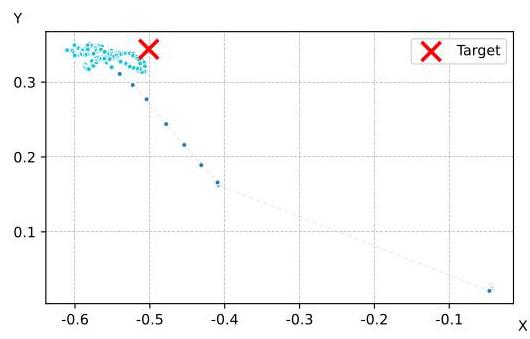
Treat gaze stabilization as a predictive temporal inference problem rather than a post-processing filter. A seq2seq model leverages historical gaze trajectories from the saccadic search phase to predict optimized, target-centered fixation points in the subsequent fixation phase. The model captures shared temporal patterns across individuals through TimesNet-based periodic modeling and a hybrid projection mechanism.
Key Components
Embedding
- Triple embedding combining token (1D conv), sinusoidal positional encoding, and timestamp linear projection to capture gaze dynamics and temporal order.
TimesNet
- State-of-the-art temporal backbone that transforms sequences into the frequency domain to extract periodic gaze patterns via multi-scale convolutions.
Fused Project
- Dual-branch projection combining multi-head self-attention for long-range dependencies and linear projection for local structure, fused via a learnable balance parameter.
Combined Loss
- MSE loss + center distance regularization + dispersion consistency, preventing global bias and over-collapse of predicted fixations.
Sliding Window
- Progressive auto-regressive training strategy that consumes model predictions incrementally, alleviating exposure bias in seq2seq inference.
Synthetic Data
- Spatial contraction and translation toward targets to generate idealized fixation sequences, expanding training diversity and improving generalization.
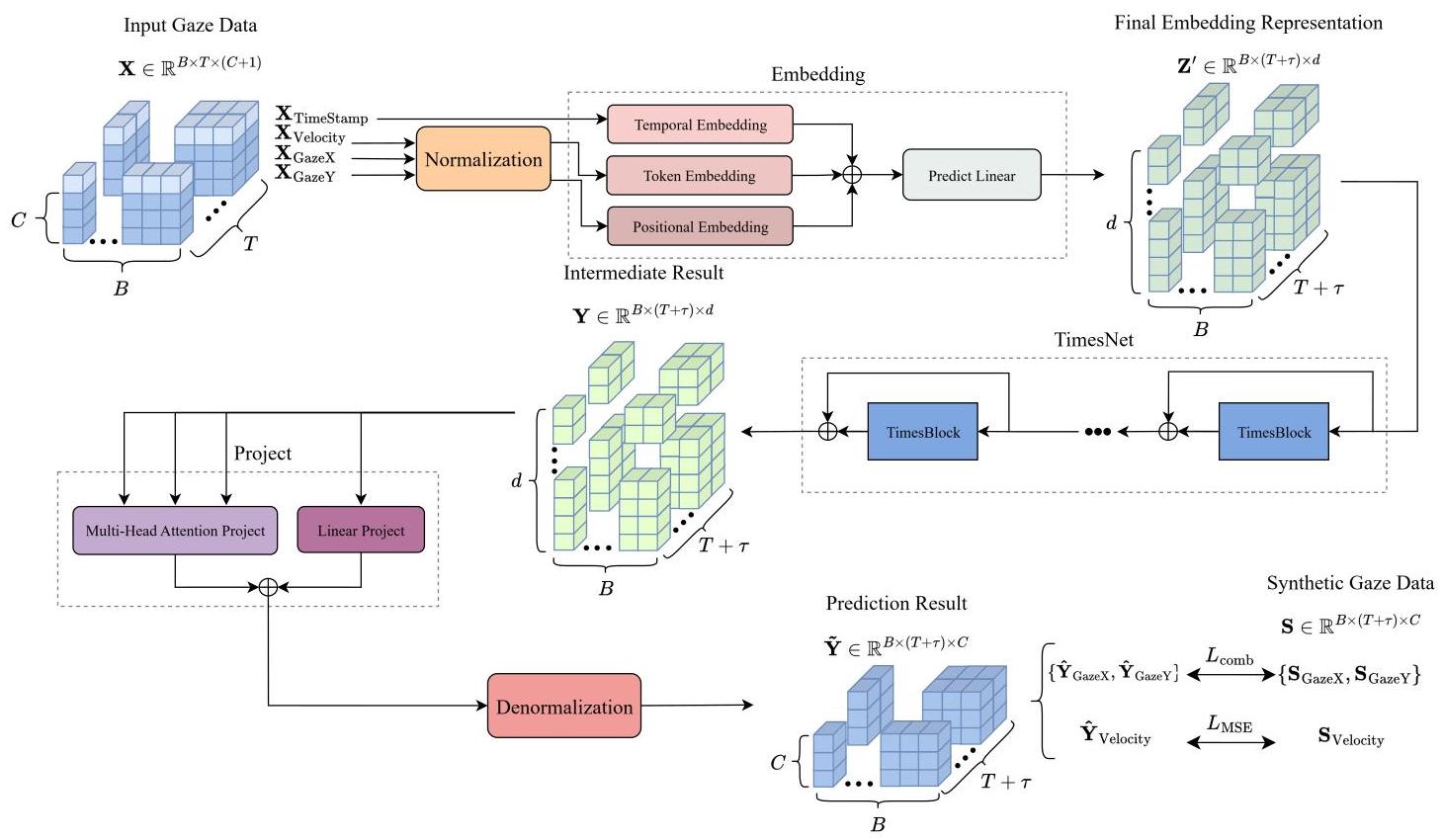
Embedding Module: Gaze coordinates and velocities are standardized per channel, then projected via 1D convolution (token embedding), combined with sinusoidal positional encoding and timestamp linear embedding. A predict linear layer extends the temporal dimension from T to T+τ.
Results
- User Study
- 0.60 ACR↑
- +17.6% vs HoloLens 2 Native (0.51)
- Average fixation completion rate
- User Study
- 30.58s ATD↓
- −6.1% vs HoloLens 2 Native (32.56s)
- Average task duration
- User Study
- 1.87 GI↓
- −12.6% vs HoloLens 2 Native (2.14)
- Gaze interruptions per trial
- User Study
- 0.26 FTR↑
- +13.0% vs HoloLens 2 Native (0.23)
- Fixation-to-threshold ratio
- MRTK Selection
- 1.77s ATD↓
- −22.7% vs Native (2.29s), d=1.26
- Target selection time
- MRTK Navigation
- 15.74s ATD↓
- −17.4% vs Native (19.05s), d=1.99
- Navigation task time
- Subjective
- 3.93 Stability↑
- +20.2% vs Native (3.27), p=0.0056
- 5-point Likert scale
- Subjective
- 4.07 Sensitivity↑
- +32.6% vs Native (3.07), p=0.0003
- 5-point Likert scale
- Quantitative
- 6.41 CI↑
- Concentration improvement over raw gaze
- Prediction horizon τ=64
- Quantitative
- 1.41 AI↑
- Accuracy improvement over raw gaze
- Prediction horizon τ=64
- Quantitative
- 0.050 AD↓
- Average deviation to target (meters)
- Robust across individuals
| Metric | TimeGazer | HoloLens 2 Native | p-value | Effect Size |
|---|---|---|---|---|
| ACR ↑ | 0.60 ± 0.23 | 0.51 ± 0.25 | 0.0034** | 0.873 |
| ATD(s) ↓ | 30.58 ± 5.04 | 32.56 ± 5.14 | 0.035* | 0.917 |
| GI(count/trial) ↓ | 1.87 ± 0.48 | 2.14 ± 0.71 | 0.035* | 0.397 |
| FTR ↑ | 0.26 ± 0.10 | 0.23 ± 0.084 | 0.035* | 0.416 |
| Stability ↑ | 3.93 ± 0.42 | 3.27 ± 0.46 | 0.0056** | 1.234 |
| Sensitivity ↑ | 4.07 ± 0.46 | 3.07 ± 0.46 | 0.0003*** | 4.009 |
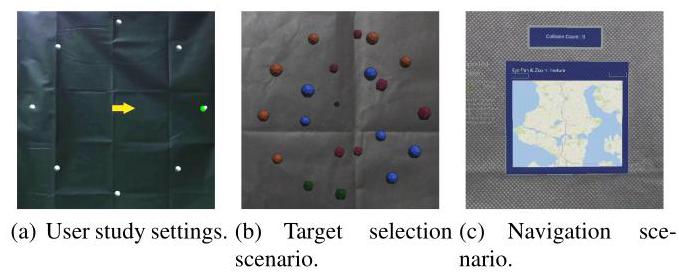
TimeGazer was deployed on Microsoft HoloLens 2 and evaluated with 27 participants in a counterbalanced user study. It significantly outperformed the native HoloLens 2 eye-tracking algorithm on all four metrics (ACR, ATD, GI, FTR) with p < 0.05. MRTK scenario evaluations further confirmed improvements in target selection (d=1.26) and navigation (d=1.99).
Conclusion
TimeGazer establishes temporal sequence modeling as a foundational paradigm for gaze-based interaction in AR. By treating gaze stabilization as a predictive, task-driven temporal inference problem, it achieves significant improvements in interaction accuracy and completion time. The model successfully distills shared temporal patterns across individuals, demonstrating robust generalization. These findings highlight the broader potential of temporal gaze modeling for advancing adaptive gaze-based interfaces in immersive systems.
Takeaway. Gaze trajectories encode rich temporal cues about user intent and attentional stability; exploiting these cues through seq2seq temporal modeling unlocks performance gains unattainable through static or geometry-only approaches.
BibTeX
@misc{xia2025timegazer,
  title={TimeGazer: Temporal Modeling of Predictive Gaze Stabilization for AR Interaction},
  author={Xia, Yaozheng and Zhu, Zaiping and Pang, Bo and Li, Sheng and Wang, Shaorong},
  year={2025},
  eprint={2510.01561},
  archivePrefix={arXiv},
  primaryClass={cs.HC},
  url={https://arxiv.org/abs/2510.01561}
}