ChronoGS: Disentangling Invariants and Changes in Multi-Period Scenes
CVPR 2026.
3D representation and change modeling for multi-period scenes.
Contribution. The first unified differentiable Gaussian-splatting framework for reconstructing multi-period scenes, jointly handling non-continuous geometry and appearance changes, accompanied by the ChronoScene benchmark dataset.
Overview
ChronoGS introduces a temporally modulated Gaussian representation for reconstructing multi-period scenes. It aggregates all periods within a unified anchor scaffold of union geometry, and disentangles stable and evolving components via temporally modulated features (period-invariant base, local period-varying, and global period-varying) together with a geometry activation mechanism.
Research Problem
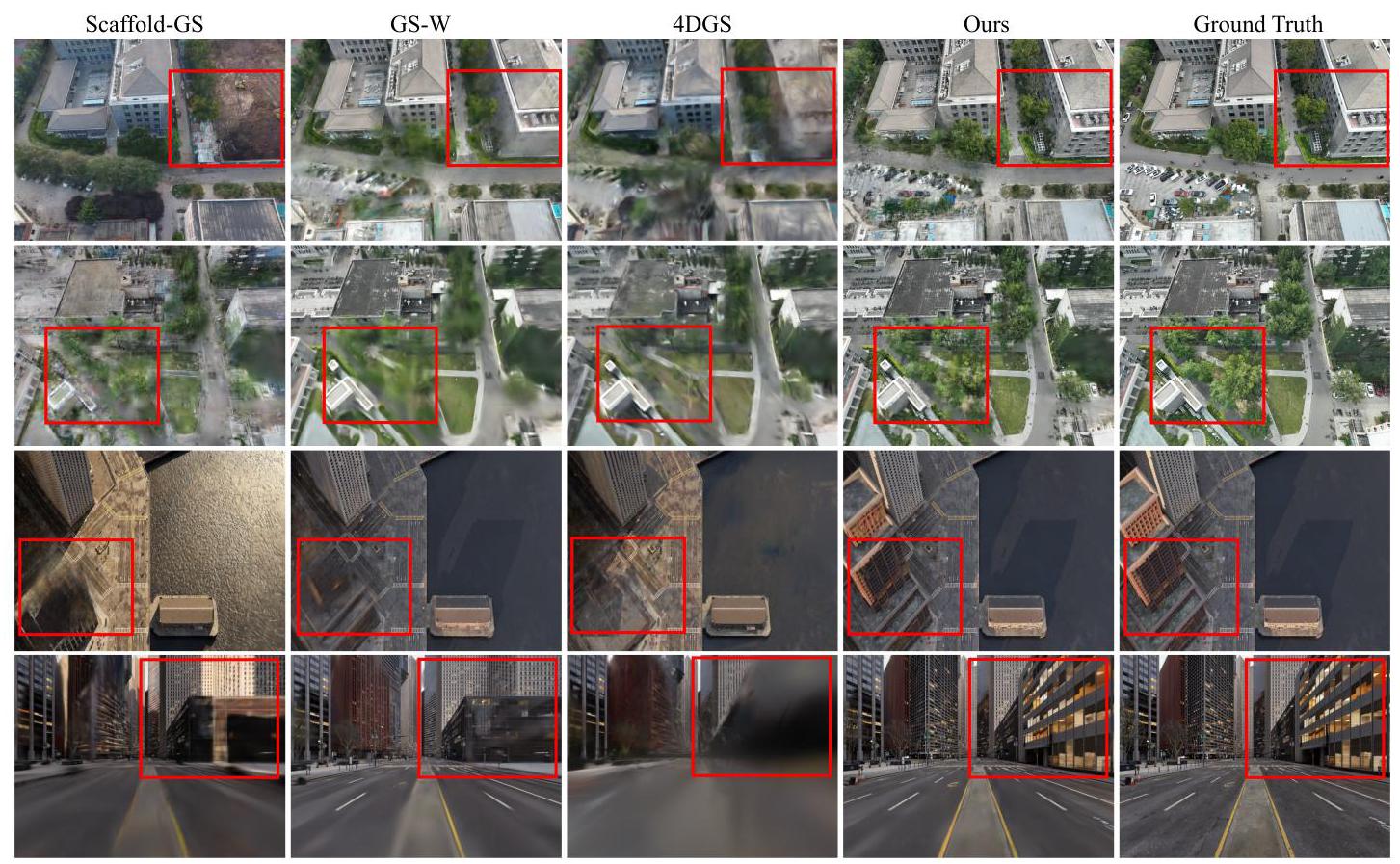
Existing static methods assume a single time-invariant geometry shared by all views, while dynamic methods rely on smooth and continuous motion over time. Neither assumption holds when captures are seasons or even years apart, leading to temporal averaging artifacts or incorrect interpolation of non-existent intermediate states.
Core Idea
Factorize a multi-period scene into a shared canonical geometry and period-specific variations. A unified anchor scaffold encodes the union geometry across all periods; each anchor maintains a period-invariant base feature and local/global period-varying features, which are decoded into Gaussian attributes by a lightweight MLP. A geometry activation mechanism automatically deactivates anchors whose predicted opacity falls below zero at a given period, enabling adaptive geometry expression while preserving global structural consistency.
Key Components
Anchor Scaffold
- A voxelized uniform grid initialized from merged sparse point clouds of all periods, covering both stable and varying geometry as a consistent backbone.
Base Feature
- Period-invariant base feature f_i^base that describes shared geometry and appearance across periods.
Local Var. Feature
- Local period-varying feature pool f_i^var storing period-specific information per anchor.
Global Var. Feature
- Global period-varying feature g(t) modeling scene-level factors such as illumination and seasonal appearance.
Temporal Encoding
- One-hot encoding over period indices with linear interpolation for inter-period positions, preserving exact representations for observed periods.
Geometry Activation
- Automatically excludes Gaussian primitives with negative decoded opacity from compositing and backprop, deactivating structures absent in specific periods.
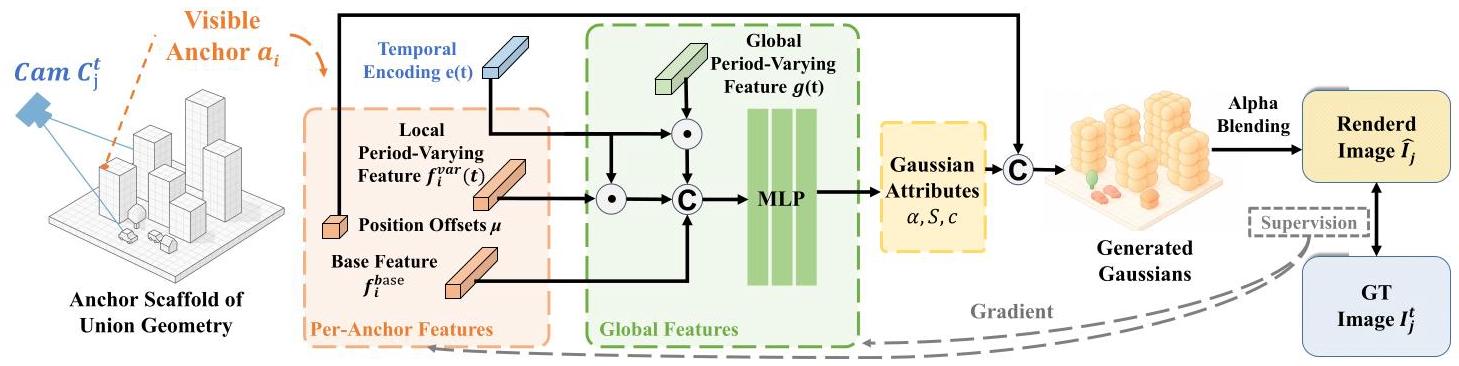
Anchor Scaffold of Union Geometry: Initialized by voxelizing merged sparse point clouds from all periods, covering both stable and varying geometry to provide a consistent geometric backbone for cross-period reconstruction.
Results
- ChronoScene Real
- 22.16 PSNR↑
- +1.25 vs realtime4DGS
- Averaged over 6 real-world scenes
- ChronoScene Real
- 0.6533 SSIM↑
- +0.1409 vs realtime4DGS
- Averaged over 6 real-world scenes
- ChronoScene Real
- 0.3390 LPIPS↓
- −0.1553 vs realtime4DGS
- Averaged over 6 real-world scenes
- ChronoScene Synthetic
- 28.80 PSNR↑
- +6.51 vs realtime4DGS
- Averaged over 6 synthetic scenes
- ChronoScene Synthetic
- 0.8562 SSIM↑
- +0.0788 vs realtime4DGS
- Averaged over 6 synthetic scenes
- ChronoScene Synthetic
- 0.2509 LPIPS↓
- −0.0842 vs realtime4DGS
- Averaged over 6 synthetic scenes
- Memory
- 0.52GB Real
- −90.6% vs realtime4DGS (5.53GB)
- Model storage footprint
- Memory
- 0.65GB Synthetic
- −91.2% vs realtime4DGS (7.41GB)
- Model storage footprint
| Method | Mem.↓ | PSNR↑ | SSIM↑ | LPIPS↓ |
|---|---|---|---|---|
| 3DGS | 1.01GB | 18.29 | 0.4658 | 0.4862 |
| Scaffold-GS | 0.36GB | 16.27 | 0.3749 | 0.5363 |
| GS-W | 0.23GB | 20.33 | 0.4018 | 0.5638 |
| 4DGS | 0.18GB | 19.03 | 0.4674 | 0.6085 |
| realtime4DGS | 5.53GB | 20.91 | 0.5124 | 0.4943 |
| ChronoGS | 0.52GB | 22.16 | 0.6533 | 0.3390 |
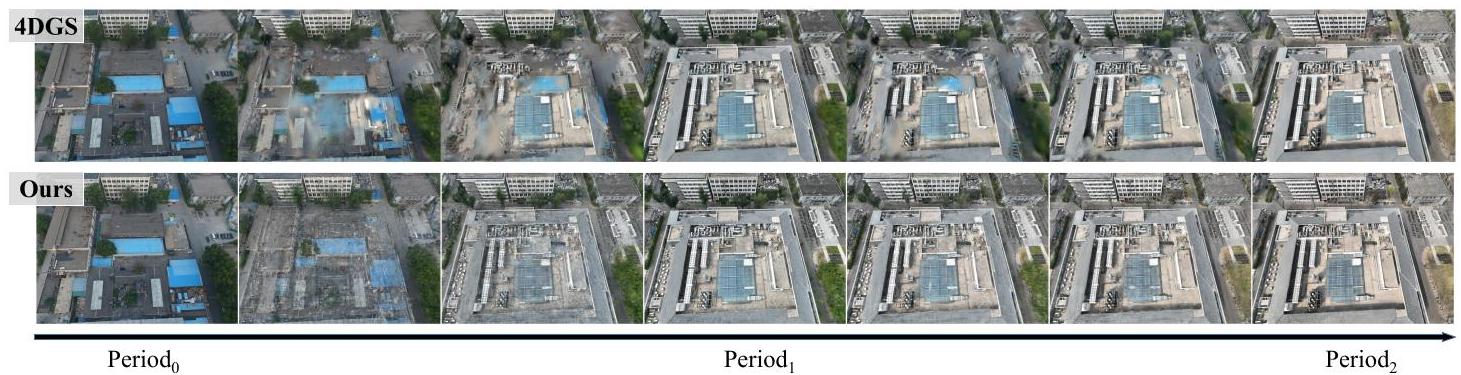
Fig. 7 shows temporal evolution renderings at continuous period indices. Compared to dynamic baselines such as 4DGS that assume smooth motion and often hallucinate intermediate structures, ChronoGS cleanly switches between periods with more plausible intermediate states.
Conclusion
ChronoGS achieves temporally consistent reconstruction of multi-period scenes through a unified anchor scaffold, temporally modulated features, and a geometry activation mechanism. Experiments demonstrate that it significantly outperforms existing baselines in reconstruction quality, temporal consistency, and storage efficiency. The release of the ChronoScene dataset establishes a principled testbed for future research on long-term intermittent scene evolution.
Takeaway. By decomposing multi-period scenes into shared canonical geometry and period-specific variations through a unified scaffold + temporally modulated features + geometry activation, faithful period-specific reconstruction with cross-period consistency can be achieved in a single model.
BibTeX
@inproceedings{wang2026chronogs,
  title={ChronoGS: Disentangling Invariants and Changes in Multi-Period Scenes},
  author={Wang, Zhongtao and Dai, Jiaqi and Zhu, Qingtian and Li, Yilong and Su, Mai and Zhu, Fei and Gai, Meng and Wang, Shaorong and Pan, Chengwei and Chen, Yisong and Wang, Guoping},
  booktitle={Proceedings of the IEEE/CVF Conference on Computer Vision and Pattern Recognition},
  year={2026}
}